


Sainsbury Laboratory: Thinking Path
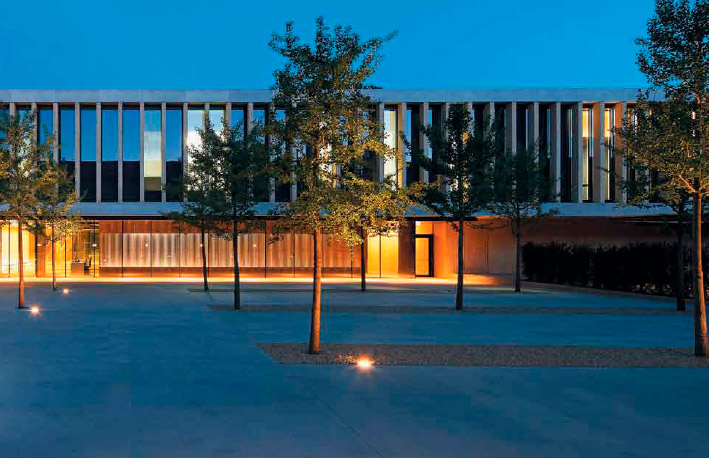
Stanton Williams’ Sainsbury Laboratory has won the 2012 RIBA Stirling Prize. Now in its 17th year, the RIBA Stirling Prize is the UK’s most prestigious architecture prize, awarded to the architects of the best new European building built or designed in the UK. This building is an exciting new typology, with spaces for research juxtaposed with those for education, the private and the public and the highly-technological nurture of nature with the simple enjoyment of an extended botanic garden.
The RIBA Stirling Prize judges said: “The Sainsbury Laboratory is a timeless piece of architecture, sitting within a highly sensitive site (...). In this project Stanton Williams and their landscape architects have created a new landscape, a courtyard which flows out into the botanical gardens. The project is both highly particular and specialized, and at the same time a universal building type, taken to an extraordinary degree of sophistication and beauty.”
“The project seems simple, and this hides the fact that it was a hugely difficult building to achieve. It needed to provide flexibility for future changes in scientific practice, and it has achieved this brilliantly. The building had to balance openness with stringent requirements for security, which was done by placing the laboratories on the first floor, together with their own meeting places. Public access is on the ground floor in the form of a lecture theatre and meeting rooms, and, importantly, there is a charming café open to the public, which sits between the gardens and the lab’s private courtyard, and from which one can watch the goings-on within. This forms the buffer between the private and public zones.”
LOCATION
The Sainsbury Laboratory is located on the northern edge of the University of Cambridge’s botanic gardens, approximately 2 miles from Cambridge city centre and half a mile from Cambridge rail station. The Sainsbury Laboratory, an 11,000 sq.m plant science research centre set in the University of Cambridge’s Botanic Garden, brings together world-leading scientists in a working environment of the highest quality. The design reconciles complex scientific requirements with the need for a piece of architecture that also responds to its landscape setting. It provides a collegial, stimulating environment for innovative research and collaboration. The building is situated within the private, ‘working’ part of the Garden, and houses research laboratories and their associated support areas. It also contains the University’s Herbarium, meeting rooms, an auditorium, social spaces, and upgraded ancillary areas for Botanic Garden staff, plus a new public café.
The project was completed in December 2010, and the opening ceremony took place in January 2011.
An architectural promenade forms the heart of a building which celebrates botanical research through interaction, communication and a connection with nature. From the front to the back, the building progresses from a grand, colonnaded façade to an open balcony and glazed public café set within a botanic garden.
The building as a whole is rooted in its setting. There are two storeys visible above ground and a further subterranean level, partly in order to ensure efficient environmental control, but also to reduce the height of the building. The overall effect is strongly horizontal as a result. Solidity is implied by the use of bands of limestone and exposed insitu concrete, recalling geological strata and indeed the Darwinian idea of evolution over time as well as the permanence which one might expect of a major research centre. At the same time, however, permeability and connections – both real and visual – between the building and the Garden have been central to its conception.
Sustainability through flexibility in long-term use is achieved through an adaptable façade behind the limestone pillar façade, enabling the research spaces to grow and change as required by the scientists. Despite the high energy demands of laboratories, the building has achieved a BREEAM excellent rating, aided by 1,000 square metres of photovoltaic panels and extensive natural lighting even in the laboratories. These top-lit labs are arranged on one floor in an L-shape, encouraging interaction between scientists.
Full content of this issue you can read here
The full version of the article can be read in our printed issue, also you can subscribe to the web-version of the magazine
 Materials provided by Stanton Williams Architects Photo: © Hufton + Crow